Ten Days Before the Board Meeting: How an ACO Finds the Real Reason It Is Missing Plan
by Yubin Park, Co-Founder / CTO
Ten days before the board meeting, the CFO receives an updated forecast: the ACO is projected to finish $4.2 million below its shared savings plan.
The CEO asks a reasonable question:
What changed, and what can we still do about it?
The problem is that an ACO rarely misses plan for one reason.
The apparent cost increase could come from avoidable admissions, a change in provider behavior, incomplete claims, attribution shifts, coding intensity, post-acute leakage, or a network that no longer fits the population. Several of these can be true at the same time.
The organization and financial figures in this scenario are illustrative.
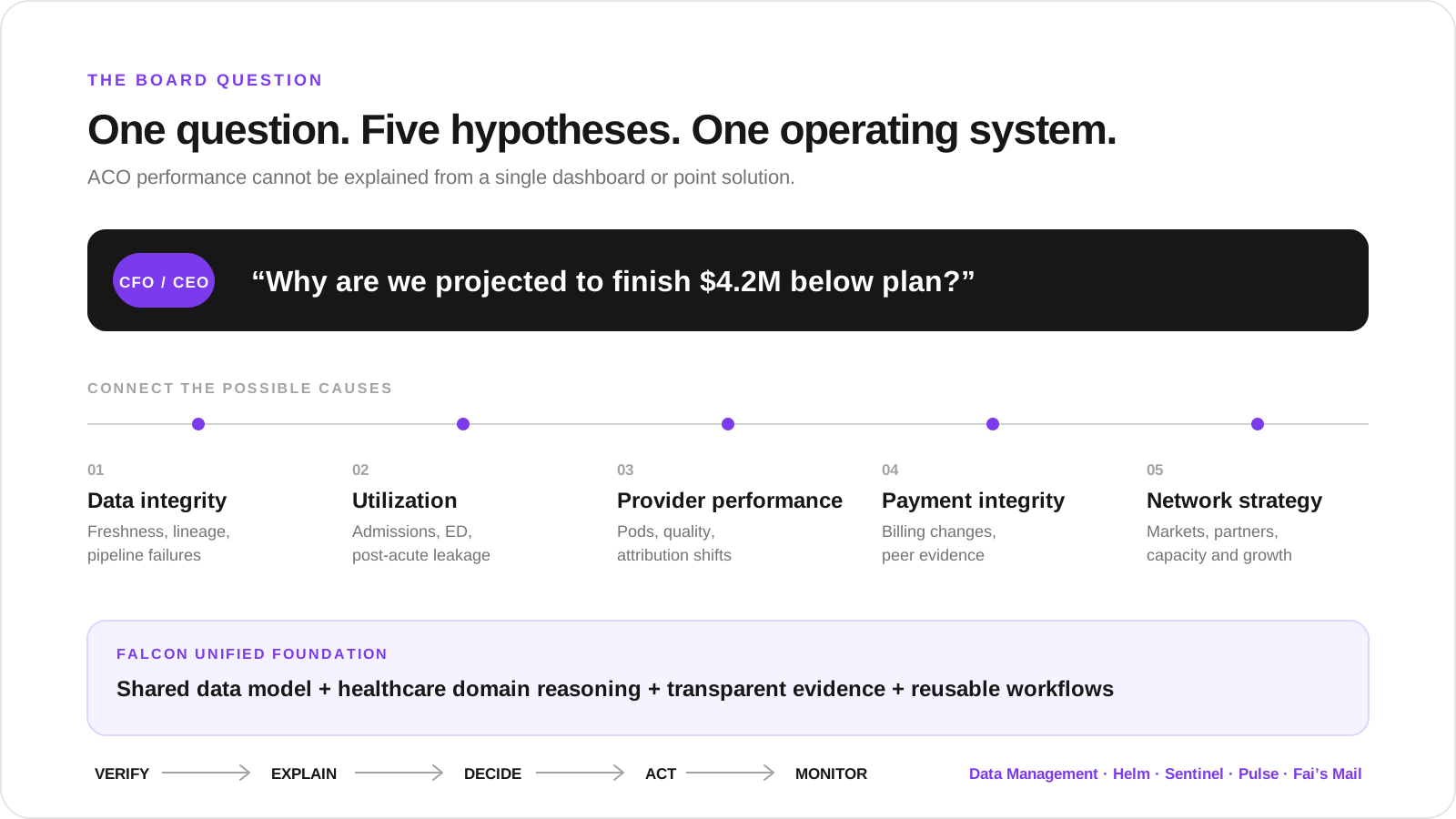
The board-level question crosses data, clinical operations, provider performance, payment integrity, and growth strategy. Falcon provides a shared foundation for testing each hypothesis and carrying the answer into action.
Start by questioning the data
Before explaining performance, the leadership team needs to know whether the underlying information is complete.
Did the latest claims file arrive? Did the attribution pipeline finish? Are the financial reports current? Did a transformation fail silently?
Falcon makes data sources, freshness, pipeline inputs and outputs, approved code, and execution history visible. The CFO does not need to accept a number simply because it appeared on a dashboard.
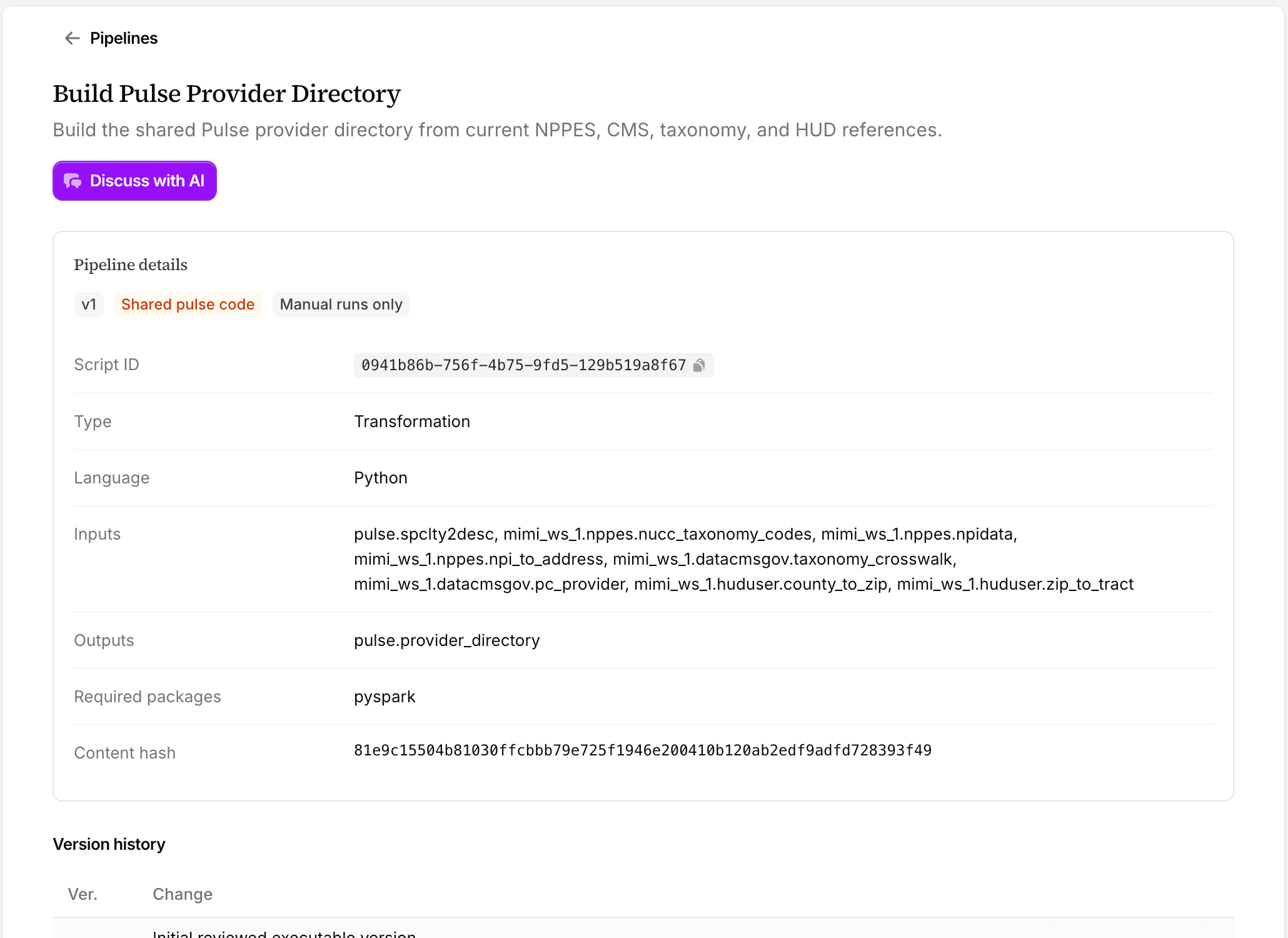
Pipeline lineage, approved code, versions, and execution details help leadership distinguish a real performance change from stale, incomplete, or incorrectly transformed data.
This first step can change the entire conversation. A late claims file requires a different response from a real increase in inpatient utilization.
Follow the problem across the ACO
Suppose the data is current. Helm shows that most of the forecast change is concentrated in two provider pods, with higher admissions, weak follow-up after discharge, and quality gaps among a relatively small member population.
That is useful, but it is not yet an explanation.
Sentinel tests another hypothesis: is the spending change clinically plausible, or is unusual billing behavior contributing to it? Instead of producing another opaque score, it prioritizes providers using visible billing signals, peer comparisons, evidence scope, and dollar context.
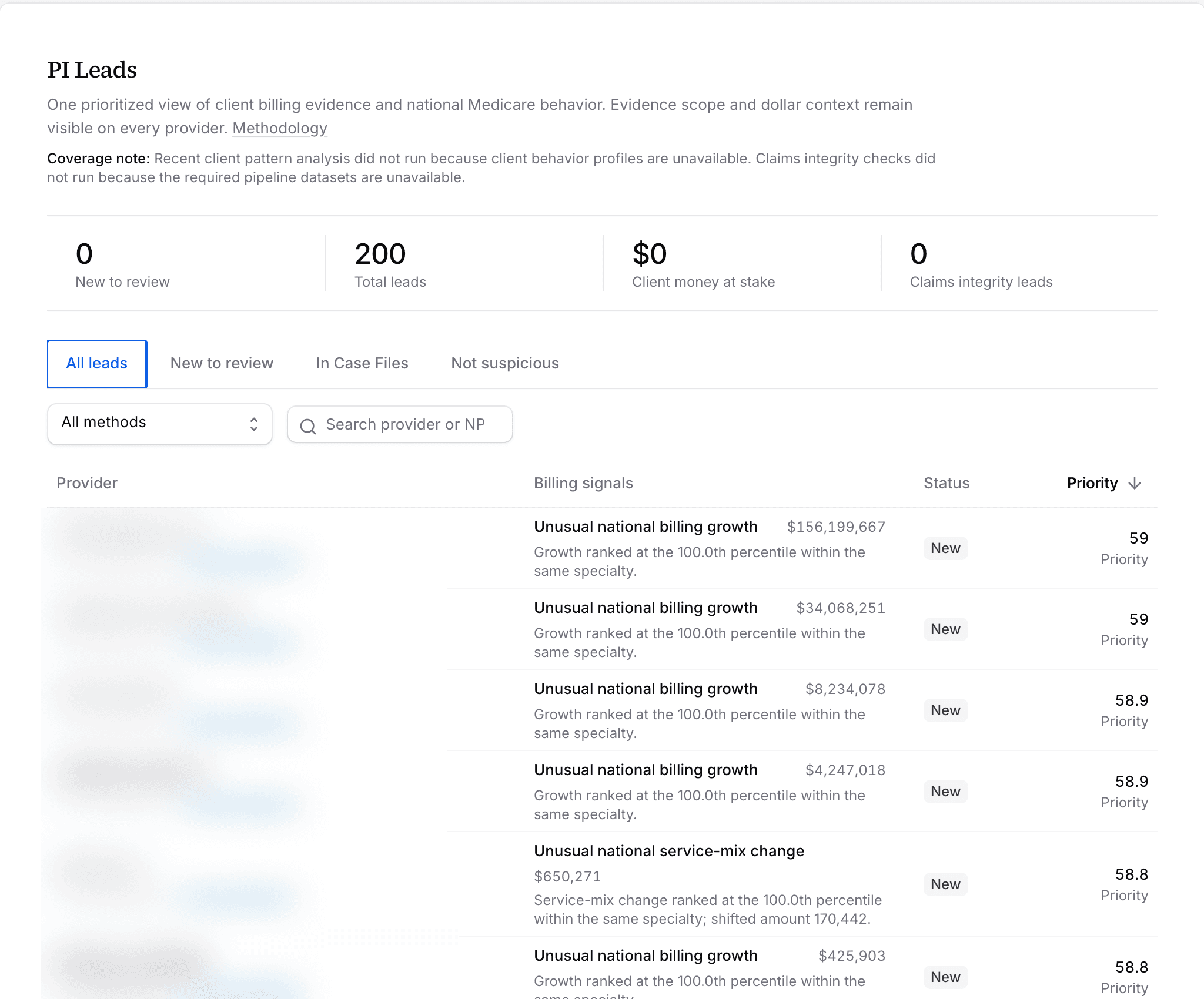
Sentinel keeps the billing signal, dollar context, peer comparison, and review priority together. Provider names and NPIs are anonymized in this image.
The answer may be mixed. One provider group may need operational support. One facility may require a coding review. Another apparent problem may disappear once incomplete data is corrected.
That is why the original question could not be answered by a utilization dashboard, an FWA tool, or a provider scorecard alone.
Decide whether to fix, replace, or grow
The CEO also needs to look forward.
If a provider relationship is deteriorating, should the ACO invest in improvement, add primary care capacity, strengthen post-acute coverage, or reconsider the partnership? Pulse lets leadership compare the broader ACO market using beneficiary scale, savings, quality, program structure, and earned savings.
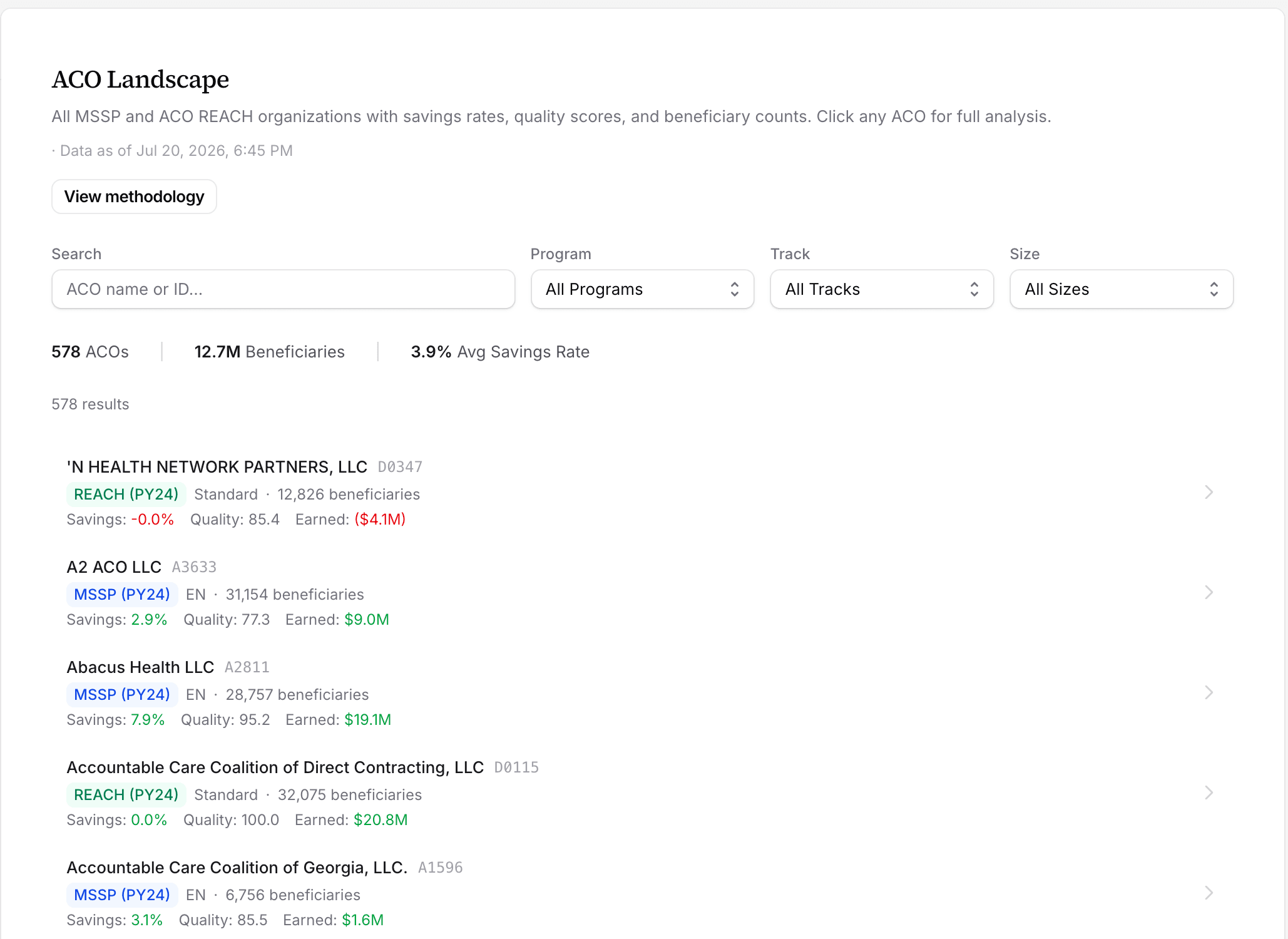
Pulse places organizations side by side so the CEO can compare scale, performance, and program economics before deciding where to invest, partner, or expand.
This turns business development into part of the performance strategy—not a separate spreadsheet maintained by another team.
Keep working after the meeting
The investigation should not end as a slide deck.
Falcon can turn the conclusions into provider chase lists, case files, tickets, reusable analysis skills, reports, and scheduled monitoring. A useful investigation does not have to be reconstructed from scratch the next time the same question appears.
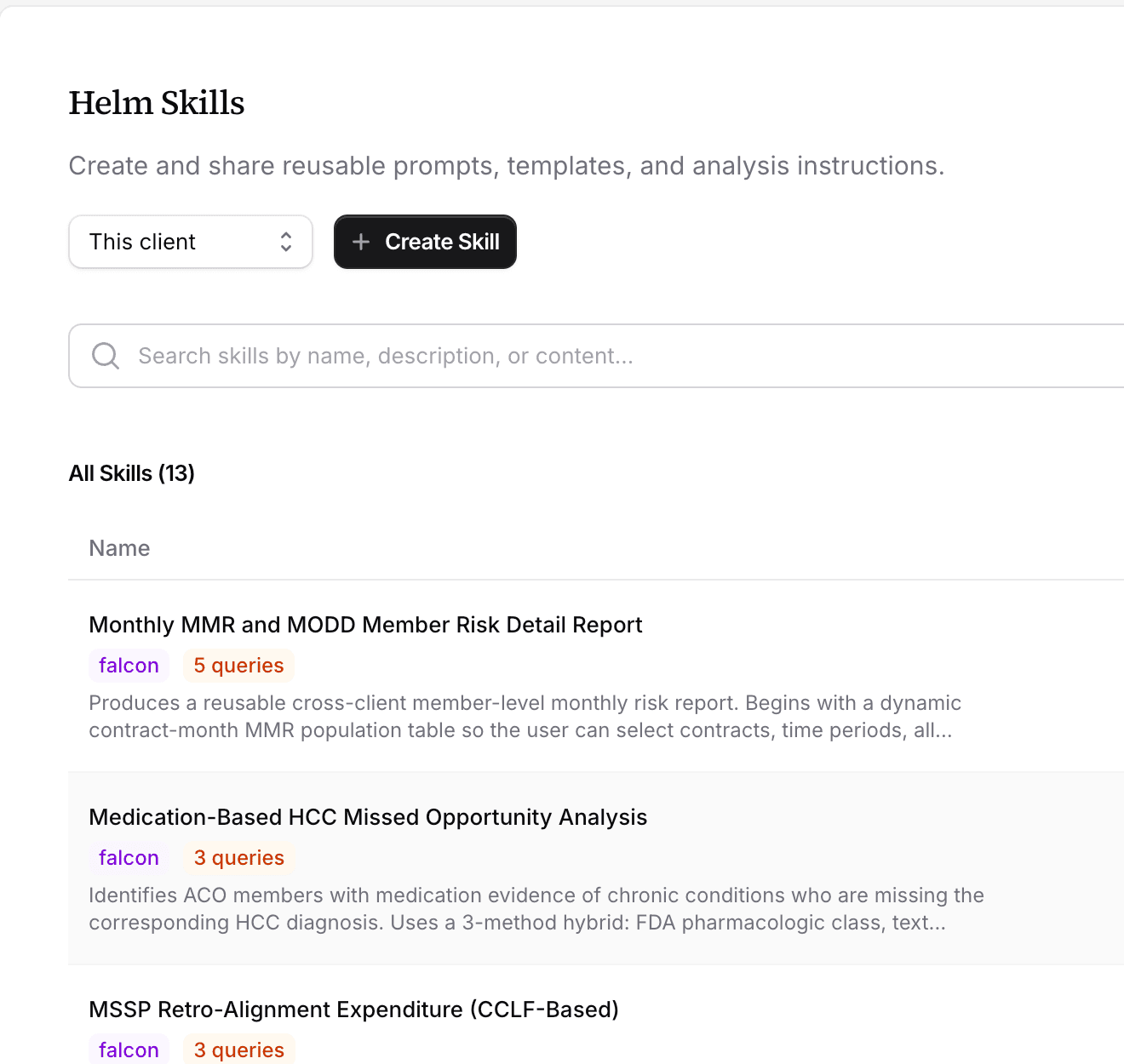
Skills preserve domain-specific prompts, queries, methods, and instructions so the next analyst—or the AI—can repeat a trusted approach across clients and reporting periods.
Executives can also email Fai at fai@falconhealth.ai with a question or attachment. Falcon performs the analysis, replies by email, and preserves the work in an auditable ticket and report trail.
The CFO can ask the real question in plain language. The clinical, financial, network, payment-integrity, and data teams can see how the answer was produced. And the organization can continue monitoring the decision after the board meeting.
One foundation for a multifaceted problem
Falcon does not assume whether the problem is utilization, provider behavior, network design, payment integrity, or data quality.
It investigates across all of them—on one flexible and transparent foundation—so ACO leaders can move from question to evidence to decision to action without waiting for five point solutions to agree.