Healthcare Data Platforms in 2026: A Practical Market Map
by Yubin Park, Co-Founder / CTO
Search for a “healthcare data platform” and the results are strange. One list can hold an infrastructure service, an EHR module, a data-exchange network, a population health app, and an analytics product.
They don't do the same job.
So the useful question isn't which platform is best. It's which layer of the problem you need to solve.
Key Conclusions
- “Healthcare data platform” really covers two questions: where a product sits in the stack, and how much work it can take on.
- Broad platforms and focused apps often work together. The right choice depends on the decision you face, the systems you already run, and the work you need to finish.
- Falcon is an AI-native layer for intelligence and data operations. It handles recurring workflows and the long tail of new, one-off projects.
How We Built This Landscape
We reviewed public product pages and documentation as of October 15, 2026. We picked nine organizations to show different product categories. These categories matter to health plans, health systems, ACOs, and other risk-bearing providers.
This is a sample, not a full vendor directory or a ranking. We did not test the products. We did not check private customer results, compare pricing, or review security and implementation. Capabilities can also change after we publish.
Falcon Health is on the list, and Falcon publishes this article. Keep that conflict in mind as you read. The same limit applies to every company here: each summary reflects public materials, not an independent check of performance.
Nine Products, Several Different Jobs
| Organization | Primary role | Publicly emphasized use case | Important distinction |
|---|---|---|---|
| Arcadia | Healthcare-specific data and intelligence platform | Unifying clinical, claims, and operational data with analytics, registries, workflows, and embedded AI | A broad enterprise platform rather than a single-purpose application |
| Innovaccer | Healthcare intelligence and data-activation platform | Unifying and activating healthcare data across population health, care management, financial performance, and AI workflows | A broad application platform serving provider, payer, public-sector, and life-sciences use cases |
| Epic Healthy Planet | EHR-centered population health | Combining clinical and payer data for risk stratification, care coordination, and patient outreach | Closely connected to the Epic clinical workflow and ecosystem |
| Datavant | Data connectivity, exchange, and collaboration | Securely exchanging, retrieving, linking, and activating health data across organizations | Connectivity remains a center of gravity, but Datavant's portfolio has expanded beyond it, including through acquisitions |
| Clarify Health | Provider, referral, and network intelligence | Combining quality, capacity, contract, market, and claims evidence to guide referral decisions | An analytics and activation layer rather than general-purpose data infrastructure |
| Cotiviti | Payer performance and interoperability | Payment accuracy, data exchange, risk adjustment, encounter management, and Quality and Stars | A broad payer-operations suite, including the capabilities of Edifecs, rather than a single analytical application |
| HealthEdge | Payer core administration and operations | Claims administration with payment integrity, risk adjustment, care management, provider data, and encounter modules | A payer operating foundation; adopting or replacing a core system is a different decision from adding an intelligence app |
| Reveleer | Risk adjustment and quality enablement | Unifying clinical data for prospective and retrospective risk adjustment, quality improvement, and member management | Focused on risk and quality workflows rather than broad enterprise data infrastructure |
| Falcon Health | Operational intelligence and data operations | VBC performance and network benchmarks, payment and payer-policy intelligence, care operations, and encounter submission | A focused application layer, not an EHR, payer core, or general-purpose lakehouse |
Many other strong products could appear in a wider review—Health Catalyst, Inovalon, Optum, Oracle, and more. Leaving them out is not a judgment about quality.
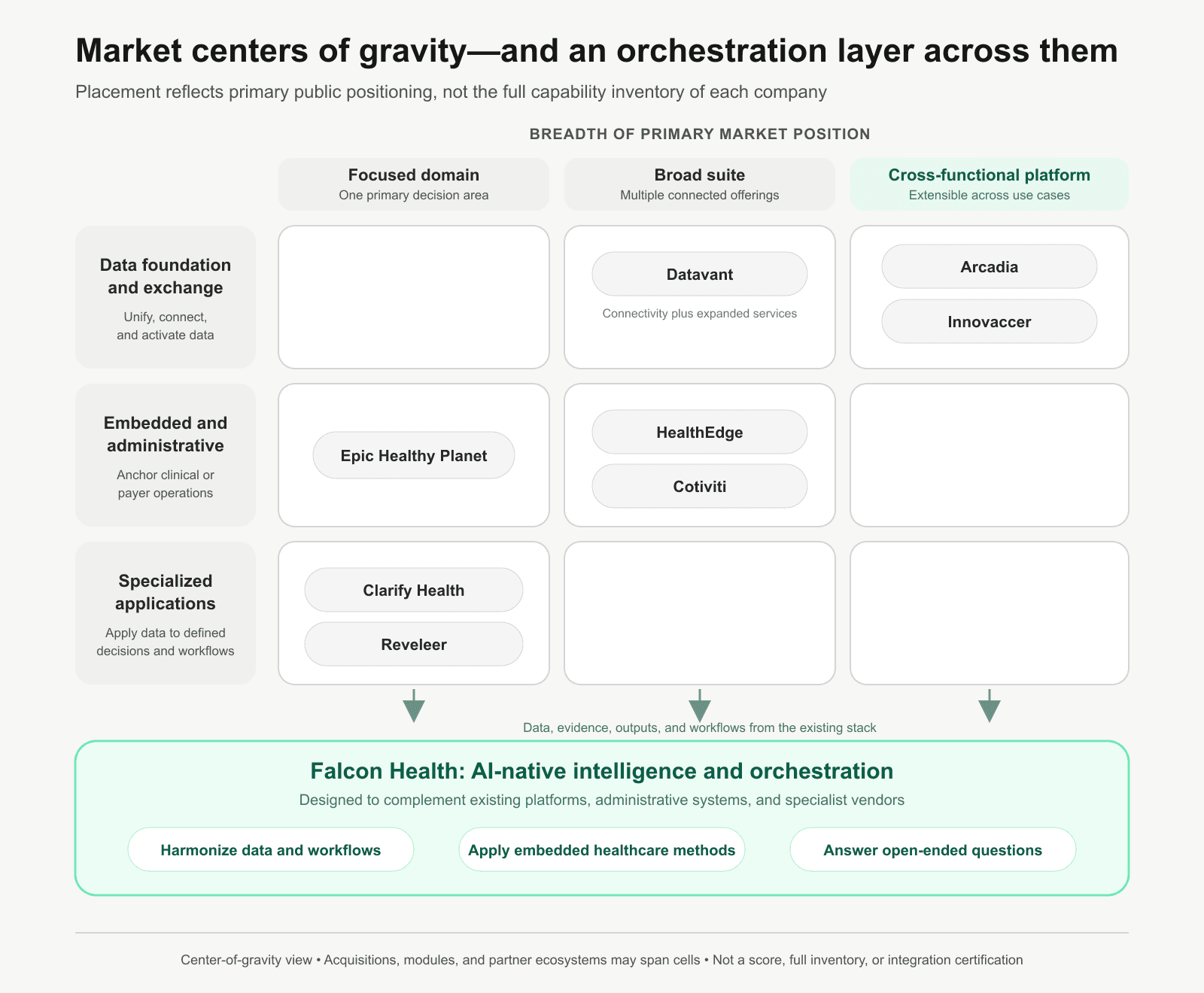
Arcadia and Innovaccer pair broad data foundations with large application portfolios. Datavant now reaches beyond connectivity, partly through acquisitions. HealthEdge and Cotiviti span many payer workflows. We place each company by its main public positioning, not every module it sells. Falcon sits apart because it is built to work across an existing stack. That does not imply a prebuilt or certified integration with any company shown.
The Market Is Easier to Understand in Layers
1. Healthcare data and intelligence platforms
Broad platforms combine data integration with healthcare models, analytics, apps, and workflows. Arcadia positions Ascent as a longitudinal data and intelligence foundation. Innovaccer describes its platform as unifying and activating data across provider, payer, population-health, care-management, and financial workflows.
These products often compete for the same enterprise programs. Even so, read each proposal closely. Check the source systems, measures, apps, implementation services, and workflows it actually includes.
2. Data infrastructure
Cloud data infrastructure is still an important layer, even though no infrastructure vendor is a featured row in the table. Services like AWS HealthLake give teams managed storage, transformation, APIs, and analytics components to build their own solutions.
Infrastructure alone does not give care-management and finance teams their measures, work queues, interventions, or operating methods. Decide what you need: building blocks, a healthcare application platform, or both.
3. EHR-centered population health
EHR-centered products put population insights next to clinical work. Epic describes Healthy Planet as using payer claims and clinical data to stratify populations and support outreach and care coordination.
That closeness helps organizations built around one EHR. If you work across many EHRs, independent providers, or payer networks, check how the product handles outside data and workflows.
4. Connectivity and exchange
Connectivity platforms solve a different problem: how to link, protect, retrieve, and exchange records across organizations. Datavant describes its platform as a secure data-collaboration layer for providers, payers, life sciences, government, and research.
Connectivity can be essential to the wider architecture. But moving data is not the same as deciding which patient needs follow-up, or explaining why spending changed.
5. Payer core and administrative operations
Payer operating platforms anchor claims administration and the workflows around it. HealthEdge describes an end-to-end suite: core administration, payment integrity, risk adjustment, quality, care management, member engagement, provider data, and encounters. Cotiviti is a broad payer-operations suite too. It spans payment accuracy, interoperability (including Edifecs), risk adjustment, encounter management, and Quality and Stars. Its focus is payer performance, not core claims adjudication.
This is a bigger commitment than adding a focused analytics or workflow app. Separate two decisions: replacing an administrative foundation, and improving one job on top of the systems you already run.
6. Focused payer and operational intelligence
Focused products begin with a decision or workflow. Clarify Health emphasizes referral and network decisions. Reveleer concentrates on clinical-data-driven risk adjustment and quality workflows. Falcon connects VBC performance and network benchmarking, payment and policy intelligence, care operations, and encounter-data submission.
This layer can sit alongside infrastructure, EHR, and connectivity products. The test is simple: does it take a team from a signal to evidence, to a decision, to an action it can track?
A More Useful Evaluation Framework
Before comparing vendors, define the work you need the system to do. Our framework weighs adaptability, speed, and operational leverage more than a standard feature checklist. That favors products that answer new questions and finish work, not just show fixed metrics. Falcon is built on that belief, so treat this as a stated point of view, not a neutral score.
- Work completed: Does it stop at a dashboard? Or can it investigate, build evidence, produce a deliverable, create a worklist, support outreach, and track what happens next?
- Time to a new answer: A policy changes, or a new provider, market, or financial question comes up. Can the team answer it in hours or days, without starting a new data or dashboard project?
- Range of questions: Can it handle both repeatable workflows and the long tail of new, specialized, one-off work?
- Extensibility: Can teams add data sources, methods, research tools, instructions, and workflows without waiting on the vendor's roadmap?
- Team leverage: Does it just automate an existing report? Or does it let a clinical, network, compliance, or finance team take on more projects, with more depth and variety?
- Evidence and reproducibility: Can a person see the sources, measures, attribution rules, transformations, and assumptions well enough to verify the result?
- Governed autonomy: Can AI do multi-step work while keeping access controls, human direction, review, lineage, and an audit trail?
- Architectural fit: Is it infrastructure, a system of record, a fixed application, or an intelligence layer? And what has to exist underneath it?
A long feature list can't make up for a system that can't take on the next important question.
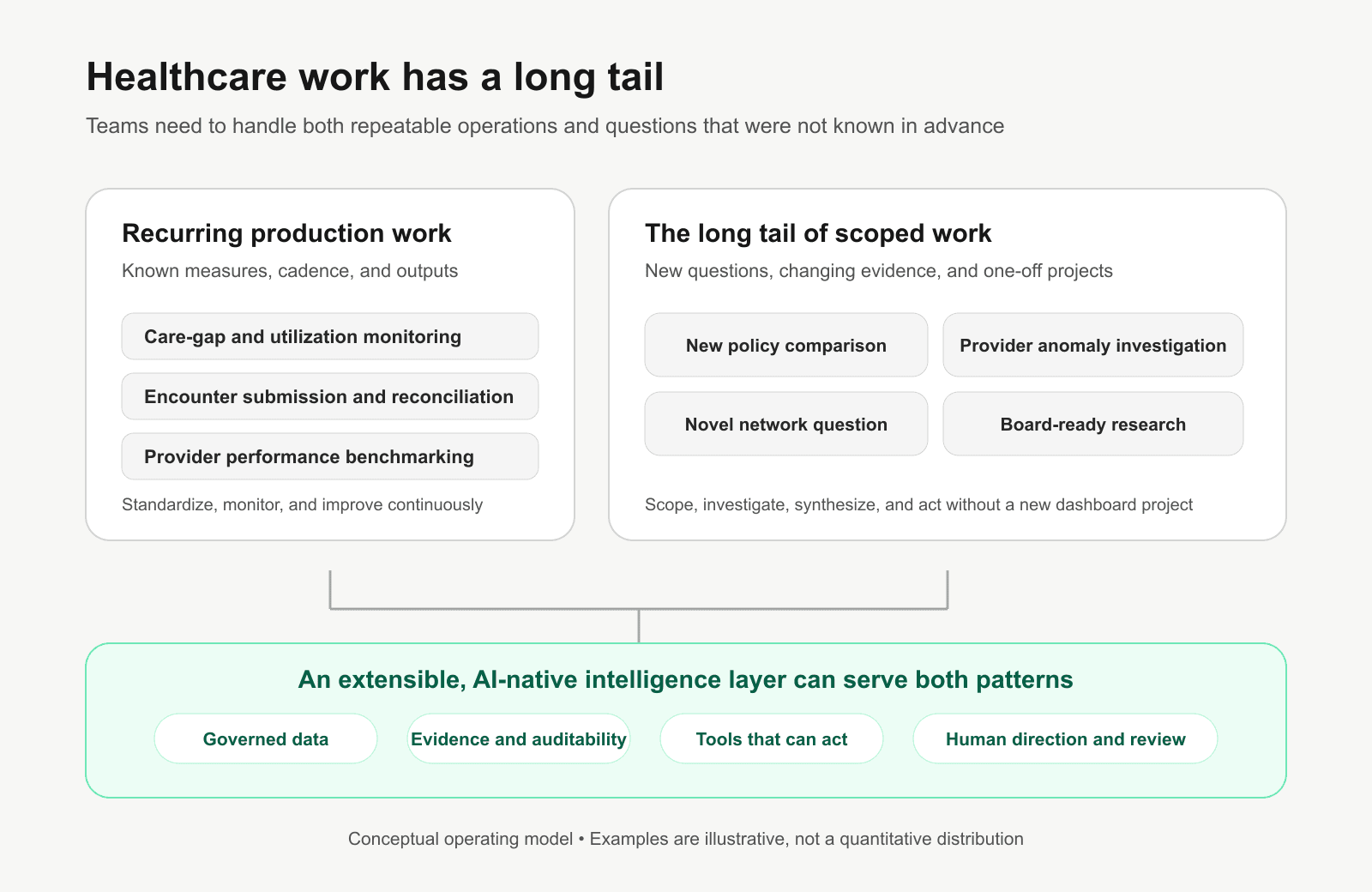
Healthcare teams need reliable production workflows. They also need a fast way to answer questions no one knew about when the software was set up. The examples are illustrative, not quantitative.
Where Falcon Fits
Falcon is an operational-intelligence and data-operations layer. It fits health plans, ACOs, PACE organizations, provider networks, and other risk-bearing organizations. It is not a replacement for an EHR, a claims-adjudication system, or a general-purpose cloud data platform.
Falcon is AI-native, not a dashboard with AI bolted on. Its apps and agents work across governed data, healthcare methods, web and policy research, and your own instructions. The goal is to expand what a team can do: keep recurring operations running, and scope and finish new work much faster.
Falcon is built to complement the vendor stack, not replace it. A client can keep its risk-adjustment vendor, EHR, payer administrator, data platform, or network-intelligence product. Falcon then harmonizes the data and outputs, streamlines work across teams, and investigates questions that cross system lines. It pairs that evidence with a deep healthcare knowledge base, built-in analytical methods, and AI agents that can reason through open-ended work.
Its applications address a connected set of value-based-care and payer workflows:
- Helm links member alignment, quality measures, utilization, care gaps, and provider follow-up.
- Pulse uses Medicare data to compare VBC performance across PCPs, specialists, ASCs, ACOs, and more. It supports both performance management and network design.
- Sentinel investigates unusual billing and possible overpayments. It uses claims patterns, provider research, and comparative evidence from Medicare and private-payer policies.
- Scope is an AI-native encounter-data submission engine. It validates and reconciles enrollment, risk-adjustment, payment, and response data, so no encounter is dropped or left unreconciled.
If you mainly need multi-EHR clinical aggregation, patient engagement, longitudinal care planning, a payer core, or a FHIR development environment, look at the broader platforms and infrastructure products. If you need to connect VBC performance, network design, payment and policy research, care operations, and encounter submissions, Falcon's narrower focus may fit better.
There Is No Universal Winner
Healthcare organizations rarely need “a healthcare data platform” in the abstract. They need a reliable way to do a specific job inside the architecture they already have.
The best evaluation starts by separating a few things: infrastructure from connectivity, systems of record from application layers, and analytics from operational workflows. Once those lines are clear, the market is much easier to read. The best choice becomes a question of fit, not rank.
Sources
Public product materials reviewed October 15, 2026: